
YOUR DOG'S DIET
When your puppy goes home at approximately eight weeks of age, they will already be gently transitioned to a high-quality puppy kibble. This transition is done gradually and thoughtfully to support healthy digestion and reduce stress during this important developmental stage. Kibble is slowly introduced alongside their fresh diet so puppies become familiar with its taste and texture before leaving our care. This ensures a smooth adjustment in their new home and provides owners with a practical, balanced feeding option from day one.
We recommend the following feeding intervals:
-
2–6 months: up to 5 meals daily
(9:00 AM, 12:00 PM, 3:00 PM, 6:00 PM, 9:00 PM) -
6–12 months: up to 3 meals daily
(9:00 AM, 3:00 PM, 9:00 PM) -
12 months and older: 2 meals daily
(9:00 AM and 9:00 PM)
Always walk your puppy or dog first, then feed once you return home.
Dogs thrive on routine, and your puppy will quickly learn to anticipate meals when they are fed at consistent times each day. A regular schedule supports digestion, behavior, and overall well-being. That said, life happens. Occasional emergencies or unexpected changes are normal, so if you typically feed four meals a day but can only manage three on a particular day, that is perfectly acceptable. Simply adjust as needed and move forward without stress. Fresh water should always be available. We strongly advise against free feeding or allowing puppies access to open food bags or unattended food, as this can lead to overeating and poor eating habits. Monitor your puppy closely and be prepared to adjust portion sizes as they grow. Use the recommended daily calorie intake listed on your food packaging, divide it by the number of daily meals, and if a feeding is skipped, slightly increase the next meal rather than doubling portions. German Shepherd Dogs, in particular, should be fed smaller, more frequent meals rather than one large meal per day, as this helps reduce the risk of bloat—a very real and serious condition in the breed. Unlimited or oversized portions should always be avoided. We also recommend transitioning to an adult formula kibble around 12 months of age, regardless of the manufacturer’s guidelines. This helps slow the rate of growth and reduce the risk of panosteitis (“growing pains”), supporting healthier long-term joint and bone development.
When our puppies are going home at age of eight weeks, they are started on kibble puppy food. We feed them 5 times a day, about 3/4 cup per pup each time. We add hot tap water to the kibble and let it stand for at least five minutes to soften the dry food and to release flavors. We add fish oil, sea kelp and vitamins to the dish. Each puppy also receives NuVet Plus, Nu-Joint Plus and Maxi-Vet probiotic once a day.
We do not require that owners feed their puppies any specific kibble for the rest of the dog's life, especially if they already have a specific feed in mind, but we recommend that they purchase the same brand of dog food as the we have used and keep their new puppy on this feed for at least 6 months.
We are not affiliated with any dog food and we are not receiving a monetary compensation for recommending a specific brand of kibble. Raw Food is the best, and we keep advocating for that. We make our choices based on our own research and observations of our dog's digestive systems and stools.
One of the BIG mistakes that new owners make is start switching a puppy from one feed to another and doing research on dog feed AFTER they got a puppy. Do your research BEFORE you bring a puppy home. If your new puppy is not eating at home during the first days - that is because he/she is stressed. They just got taken away from mom and siblings - the only life they knew and you are a stranger yet. Give your new puppy some time to get used to you and to trust you. For as long as a puppy has fresh water at all times - they will be fine! Offer food and if a puppy is not eating, take it away after 10 minutes and wait until next feeding time to repeat. Do not take a refusal as "my puppy is not eating, they must not like this feed". Stick with the feed a breeder had a puppy on. Switching to other brand of dry dog food must be done slow - by adding new feed to the old and gradually increasing the amount. We would not recommend introducing new brand of kibble to your newly acquired puppy - but stick with a feed a breeder has been feeding in a kennel until your new puppy fully transitioned into your new home and feels comfortable. Transitions are hard and puppy is stressed already - new puppies often have stress-related diarrhea, and if switching to a new food at this time - things can get worsen quickly. Take it slow! If you notice that your puppy's stools are loose - try adding a few Tablespoons of unsweetened pumpkin puree to the diet - pumpkin should help hard then stool quickly.
SIDE NOTE: We preserve our pumpkins from the pumpkin patch every year. We wash the pumpkins, cut them in halves and bake in our oven at 350F until fully cooked. Sometimes there will be liquid in the pumpkin that we drain. Then, we scoop baked pumpkin from the shell and process it in our food processor until fully pureed, transfer the puree into freezer gallon bags, label with date and store in freezer until needed. It is a very easy and cost-effective way to have a supply of all-natural unsweetened pumpkin year round.
Our Geliebte Pups Love it!
We would recommend to use puppy formula for up to 6 months of age and switch to adult formula thereafter. Commercial puppy feed is designed to make puppies grow FAST and fast is never better, especially when it comes to large breed dogs.
How to transition your dog from one brand of food to another:
1st day: 100% old brand
2nd day: 90% of old brand + 10% of new brand
3rd day: 80% of old brand + 20% of new brand
4th day: 70% of old brand + 30% of new brand
5th day: 60% of old brand + 40% of new brand
6th day: 50% of old brand + 50% of new brand
7th day: 40% of old brand + 60% of new brand
8th day: 30% of old brand + 70% of new brand
9th day: 20% of old brand + 80% of new brand
10th day: 10% of old brand + 90% of new brand
11th day: 100% of new brand
While we do not require owners to stick with a particular brand of dog food, we do require that if they choose to feed their dog dry food, they purchase super premium class food, with meat being first ingredient, no corn or "by-product meal" - type of dog food. We also require that owners are consistent with the feeding schedule, do not switch from one dog food to another without a good reason and keep the dog in 3/5 Body Conditioning Score.
Feeding the dog irregular, imbalance diet voids our health guarantees.
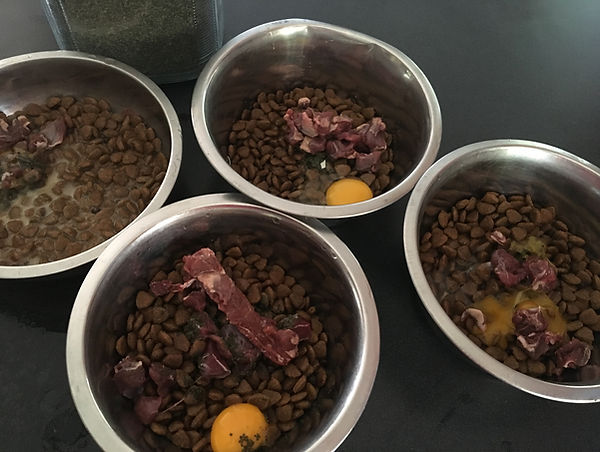
Plates of Dry Dog Food with hot water, Sea Kelp, Fish Oil, Raw Egg Yolk and pieces of raw meat.
Supplements
We are often asked what supplements we recommend and where do we buy these. We are going to make a disclaimer and say that we would not mind to get compensated for our recommendations, although at this point nobody has contacted us with such offer. The following opinions are our own and are based on our experience and the results we see with our dogs.

Once daily
a high-quality supplement that incorporates a precise formula of antioxidants, amino acids, vitamins, minerals, enzymes, herbs and more. NuVet Plus® brings together vital ingredients that perform synergistically to help improve your pet’s health and keep them healthy. Our supplement is made using Natural ingredients that are formulated in a FDA Registered Facility using CGMP standards.

Once daily
MaxiFlora is the only supplement formulated with the same probiotics found in prey intestines, along with plant-based prebiotics and natural digestive enzymes.
Maxiflora is formulated to be like 'guts in a jar'- a concentrated blend of probiotics, prebiotics and enzymes guaranteed to ensure your dog enjoys the gut health, immunity, and boundless energy of their wild relatives.

A teaspoon with every meal
NORWEGIAN SEA KELP FLAKES
Ascophyllum nodosum, or kelp, is a variety of Atlantic seaweed also known as Norwegian kelp. This aquatic plant is best known for its use in Asian cuisine as a sea vegetable. In its dried form, kelp is used to season soups and sushi. Kelp is valued as a rich source of nutrients, including calcium, magnesium, potassium, sodium and, of course, iodine. The herb is also a rich source of algin, a type of fiber capable of absorbing up to 300 times its weight in water.

Twice a week with a meal
RAW EGG YOLK
Vitamin D in eggs works in concert with calcium and protein to help strengthen and maintain strong bones in dogs. Egg yolks also contain some of the highest concentrations of the nutrient choline found in food. This nutrient helps support healthy development of the brains of puppies in pregnant dogs.

A Tablespoon once a day/ or a teaspoon with every meal.
SALMON OIL/ FISH OIL
Fish oil is one of the best supplements to add to your dog's diet. Fish oil supports your canine companion's heart health, promotes a silky coat, reduces itchy and flaky skin, and relieves allergies and joint pain. It can even strengthen their immune system and help them fight cancer.
On Raw Feeding
If you ask us what is the best food to feed your pet - we will say RAW. All commercial food, regardless of the quality and brand, is just that - processed, dry feed, "crunchy chips with vitamins". If you look at publications from 40 years ago, you will see that dog's life expectancy used to be 18-20 years and it is with the rise of commercial feed, that we witness the life expectancy of dogs to now to be only 10-12 years and if a dog makes it to 14 or 15 , it is considered "very, very old". My grandma would probably make a fool of me if I told her I am buying a bag of dry dog food from a store. Dogs are carnivores and the best food for them is raw diet.
But what is a Raw Diet? Just like it sounds - a meal made of raw ( or minimally processed) meat, meaty bones and vegetables.
Potential benefits of the raw dog food diet that supporters tout include:
-
Shinier coats
-
Healthier skin
-
Cleaner teeth
-
Higher energy levels
-
Smaller stools
-
Potential risks include:
-
Threats to human and dog health from bacteria in raw meat
-
An unbalanced diet that may damage the health of dogs if given for an extended period
-
Potential for whole bones to choke an animal, break teeth or cause an internal puncture
We have seen different opinions on what exactly goes onto the "raw meal" plate, but here are some different recipes:
Proteins = 80 % Bones = 10% Organ meat = 10%
Proteins = 70% Grains = 20% Vegetables = 10%
Proteins = 70 % Grains = 10% Bones = 10% Vegetables = 10%
As you can see from those examples, the main ingredient is MEAT (protein). This protein can be a one kind (beef only or venison only) or a combinations of a few different kinds of meat. We have seen breeders and dog owners posting images of their raw feeding plates that had meats from all kinds of animals - from bison tails and alligator paws to pork brains and duck heads. In reality, a dog does not need to have a fancy meal made from a variety of animals. They need quality lean meat.
We are very careful in all foods that we put on our table, but choosing meat & it’s source is extremely important. We are lucky to grow our own 100% Grass-fed and Grass-finished (ZERO GRAINS AT ALL) bulls and non-GMO chickens and quail on our Beloved Acres Farmstead. So, having our freezers full, we do not shop for meat in the grocery stores.
But what if we did not have our own source of meat? What are some things that we look for?
-
Having meat being LOCAL
-
Making sure it is raised without antibiotic, growth hormones, on a pasture & being grass-fed (cattle, lamb, goats, pigs) and free-range (birds).
-
Making sure it is processed without nitrates, nitrites, added water or anything else in that matter
Now, meats of this caliber are usually expensive. You would not find these cuts in large chain stores, and sometimes have to work with a farmer or travel to a butcher shop or a co-op, or place a special order with them. Over the past few years we have a privilege to meet with dozens of wonderful local farmers. Some of them are our close friends and we are very grateful for their friendship.
So, when my friends ask me for recommendations, we make those based on the criteria we listed above and not on our relationship with a farmer.
When it comes to raw feeding for dogs, we recommend LEAN beef cuts (not ground, no fat), organ meat (tripe, liver, lungs) and hard-boiled chicken feet to make gelatin for ear support (never feed raw chicken or chicken bones to dogs). We do not recommend pork for dogs, and are very careful with pork that we buy for ourselves, not for religious reasons, but because pigs do not sweat/detox and are considered the dirtiest meat anyway. We for sure love pork chops, pork ribs and bacon and when we choose pork for our family, we make sure it is raised on a pasture, which is hard to find.
We highly recommend to make a connection with a famer or a butcher and get some green tripe for your dog. You can add tripe if feeding RAW, or if feeding kibble.
Twice a week we feed our dogs TRIPE - the Healthy Green Tripe Diet. It consists of Raw Beef Tripe, with an addition of Oils, Herbs, Enzymes, Vitamins, Minerals, Organic Grains, Vegetables and Fruits. We cook their meals from scratch using raw ingredients. Yes, we care for them that much! You can for sure incorporate human foods into your dog's diet.
LEARN WHAT HUMAN FOODS DOGS CAN AND CAN NOT EAT
Here is a little info about the Tripe: the magical mystery meat that dogs crave and humans fear!
Tripe seems to be the line in the sand drawn between beginning raw feeders and the ‘been there, done that’ old pros. If you are among the uninitiated, then you will find feeding tripe to be a real treat (as will your dog). Not only will tripe provide immense health benefits for your dog, it will catapult you to the rank of seasoned raw feeder, just one rung below raw feeders who scoop road kill off the road and tote it home in their trunk to proudly offer as a gift for their furry charges!
What is tripe?
Tripe is the stomach of a ruminating (grazing) animal including cows, buffalo and sheep. The unique stomachs of ruminants have four chambers which systematically break down grasses with a slew of digestive enzymes, gastric juices and amino acids.
You may have seen tripe on the grocery store shelves in a white and bleached form. This is not what you want to feed your dog: it is devoid of any real value. What you want to feed is ‘green tripe’, the stuff that comes right out of the animal, dripping with all of those wonderful juices.
Why does it have to be green?
The same digestive enzymes and beneficial bacteria that help the ruminant animal digest foodstuff will do the same for your dog. Think how much money you can spend on digestive enzymes and probiotics in a bottle and those same wonderful, natural substances are in abundance in green tripe.
Digestive enzymes aid in digestion, meaning the body does not have to expend as much energy when digesting a meal. This means your dog gets the most nutritional benefit from his meals. Digestive enzymes also do much more than aid in digestion: they purify and cleanse the blood and remove toxins, parasites and fungus. They also improve metabolism, hormonal function and boost the immune system.
Cooking destroys digestive enzymes, so it is important that your dog’s tripe is not only green, but raw. If your dog eats a cooked or commercial diet, then he may be suffering from enzyme deficiency. The signs of this can include anxiety, lack of energy, chronic diarrhea and digestive problems, gingivitis, viral and bacterial infections and yeast overgrowth. If your dog suffers from any of these disorders, consider the value of adding green tripe to his diet or increasing the amount you currently feed.
The gut is populated by hundreds of different kinds of bacteria or microflora which are divided into the ‘good guys’ and the ‘bad guys’. The ‘bad’ bacteria are those responsible for health complaints and some of their members include e- coli, salmonella, campylobacter and listeria. These are the bacteria contained in foods and the environment that could potentially make your dog sick: if it weren’t for the protection of the ‘good’ bacteria.
The good bacteria improve immune function simply by out- numbering the bad bacteria and maintaining a healthy microflora in the gut. Green tripe is loaded with Lactobacillus Acidophilus, one of the bacterial ‘good guys’. Your dog’s gut can only feed so many micro-organisms, so the more ‘good’ bacteria he consumes, the less ‘bad’ bacteria will find anything to eat in his gut and they will get crowded out.
Many health issues are caused by imbalance in the microflora. Older dogs are especially prone to this as they tend to have lower levels of beneficial bacteria in their guts. Supplementing your dog’s diet with lots of raw, green tripe will help him maintain a healthy balance of microflora, manufacture more B vitamins, and prevent many health disorders.
If your dog already suffers from health issues, consider adding raw, green tripe to his diet. Acidophilus can be used to treat a myriad of health complaints.
More good news
Not only is tripe loaded with digestive enzymes and probiotics, it has the perfect ratio of calcium to phosphorus – 1:1. Green tripe also contains the essential fatty acids, Linoleic and Linolenic, in their recommended proportions. It can also be served in nice, large rubbery chunks which will provide your dog with good exercise and better dental health.
The bad news
The rumors you heard are true: tripe stinks! If you are really serious about your dog’s health, you will get past the smell. Instead of thinking about the horrific smell, think about all of the great stuff tripe will do for your dog. Don’t worry, those dry-heaves will go away with time!
Tripe can be a bit difficult to find. Obviously, you will not find it in the grocery store. You will also not find it in most large, federally licensed slaughterhouses. You will have to look for the smaller butchers who do custom killing. Be prepared however: they will want if off their premises as soon as possible and you may be required to supply your own buckets to take it home in.
It is also important to note that tripe does contain its share of bacteria. Use care when handling it as we humans do not have the natural resistance to harmful bacteria as our dogs do. Just wash your hands thoroughly after handling.
Finding sources of tripe can be a daunting task and when you finally find it, you will discover that the hard part is just beginning! Cutting tripe can be a nightmare for you and for your knife! You will need a very sharp knife to cut through your tripe and you might need more than one as it will dull quickly. Tripe is much easier to cut if it is partially frozen first. Forget trying to use a cutting board, the cutting will go much smoother if you hang the tripe with one hand and cut it with the other, sawing it into nice big chunks.
With time, you will see that the icky parts of tripe are far outweighed by the good parts: gloriously good health and vitality for your dog! And that rise in rank to seasoned raw feeder won’t hurt you any either!
Benefits of Lactobacillus Acidophilus
-
Treats and prevents vaginal infections
-
Treats diarrhea and GI infections
-
Aids digestion
-
Treats chronic constipation
-
Treats symptoms of Irritable Bowel Syndrome
-
Enhances the immune system
-
Lowers the risk of pollen allergies
SOURCE: http://www.dogsnaturallymagazine.com/the-stink-on-tripe/
We highly recommend to make a connection with a famer or a butcher and get some green tripe for your dog. If you are not able to find green tripe (bleached tripe from a grocery store is useless), then you can look into purchasing dried tripe or probiotics. We have done our research and found Maxi-Vet, a company that creates wonderful probiotic product.
From Maxi-Vet: The canine digestive system is meant to be provided with probiotics, prebiotics and digestive enzymes. In the wild, canines get these crucial nutrients through the consumption of wild prey intestines. But since most domesticated dogs don’t subsist off wild prey, they don’t enjoy the gut health and vitality of their wild counterparts (i.e. wolves). That’s why we started MaxiVet, with the simple goal of improving canine nutrition. After years of research, countless expert consultations, & a handful of reformulations, we’ve created MaxiFlora–the first canine supplement on the market designed to mirror the digestive benefits of consuming wild prey. It’s an all-natural, carefully formulated chew that comes with a wealth of positive, health-promoting, and symptom-relieving benefits. You can learn about their products here.
Additionally, no matter what foods you will be feeding to your dog (raw or kibble), we highly recommend that your puppy is receiving balanced daily vitamins!